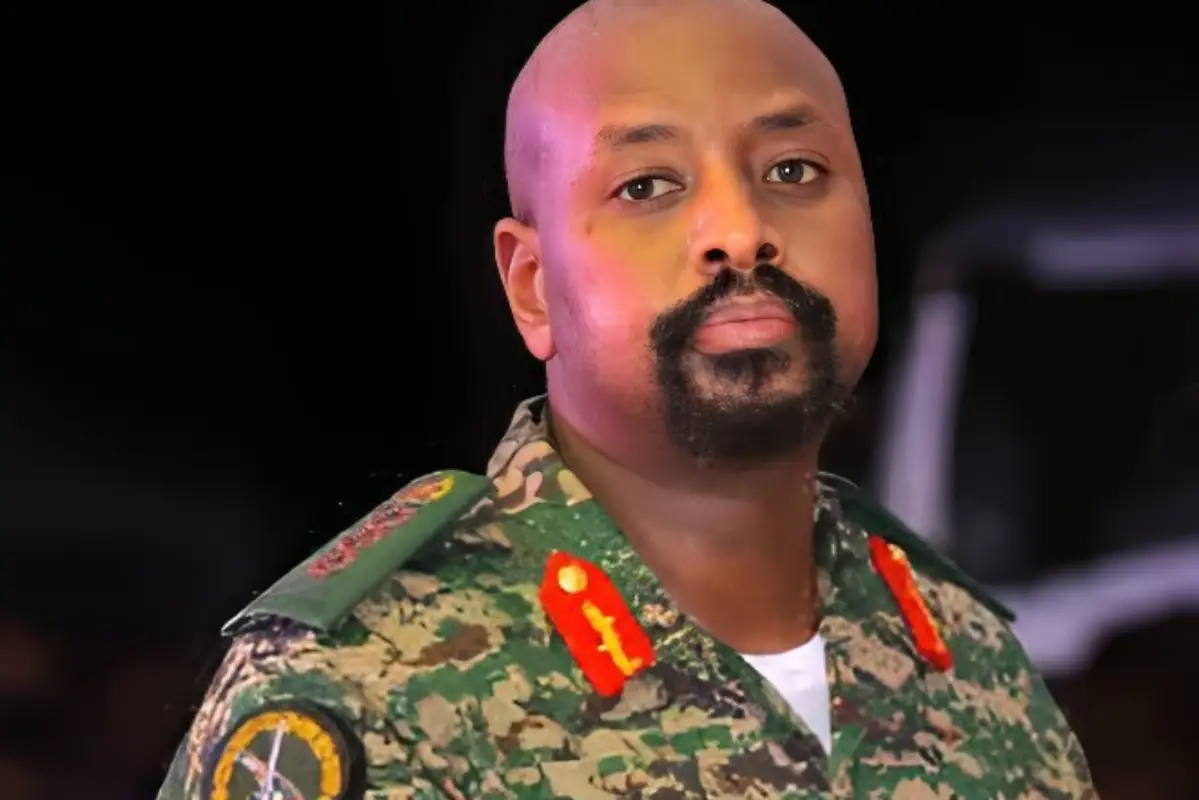

General Muhoozi Kainerugaba’s criticism of opposition leader Robert Kyagulanyi Ssentamu, popularly known as Bobi Wine, over his ties with whites is surprising.
Last week, he wrote social media posts insulting Mr Kyagulanyi and said he will never lead Uganda because of his ties with whites. But if Mr Kyagulanyi is relying on whites to further his political interests, he is following in the NRM’s footsteps.
The very first person to sell NRA/NRM to the outside world was a white man. He was born in Tanzania, where his father was a colonial officer. When the NRA (now UPDF) took power in 1986, he came to live and work in Uganda.
That man is William Pike. For nearly 20 years, he was a high-profile media personality in Uganda, having been at the helm of the New Vision Printing and Publishing Corporation as CEO and managing director.
The NRM was so impressed with the work he had done that they decided to thank him in a big way. And what did Mr Pike do for the NRM, whose leaders—and Gen Kainerugaba—are now berating Mr Kyagulanyi for meeting with whites?
MORE FROM THE FOUNDER’S MIND SPACE
In his own words, extracted from an interview with the Nairobi Law Monthly published 12 years ago, Mr Pike said that after his family returned to England, he met a Ugandan student at the School of Oriental and African Studies in London. The student was pursuing his PhD and was the London representative of the NRA rebels. Mr Pike was also a student.
They became close friends. Mr Pike was already working as a journalist, and the NRA/M wanted a muzungu who could interview Mr Museveni. To shorten a long story, he was smuggled into Uganda and interviewed Mr Museveni.
The story made headlines in newspapers, on TV and radio. “It was a big shake-up for the Obote II government, and by that stage, I had become very supportive of the NRA,” Mr Pike said.
Mr Museveni asked Mr Pike to meet the British Foreign Office and brief them on what he had seen in Uganda. Another white man named Tony Rowland lent Mr Museveni his private jet. That was white support in black and white.
Gen Kainerugaba’s criticism reminds me of a familiar Ugandan—and African—paradox: condemning whites rhetorically while relying on them practically.
Begin with small things like names. Many Ugandans prefer white people’s names to African names. In places like Kampala, six in 10 Ugandans expecting a baby (my estimate) will choose a European name.
For well-heeled Ugandans, sending a child to study at a university in Europe is a dream come true. Some Africans attend weeklong courses at Harvard or Oxford, then go to social media to replace the names of local universities with these institutions.
Many Africans with advanced degrees have written dissertations (in partial fulfillment of those degrees), but most literature reviews in those dissertations rely predominantly on books and essays written by whites.
Gen Kainerugaba and his siblings have been educated at British universities. For his military training, the army chief went to Sandhurst, UK and Fort Leavenworth, US. In one of his posts on X, Gen Kainerugaba said sons and daughters of NRM’s revolutionaries chillax in Europe munching burgers while he has to toil. Why not in Chad or Eritrea?
Six reasons you should trust what you read on this website—and share it with confidence
1. Led by experience that travels well
Our founder and editorial director, Musaazi NAMITI, brings more than two decades of serious newsroom experience, including eight years as an editor at Al Jazeera in Doha, Qatar, and consulting for the African Development Bank, UN agencies and Globe Media Asia in Cambodia. His global exposure anchors OJ-UGANDA.COM in professional rigour and fairness—standards that too often slip in Uganda’s crowded media space.
2. We fact-check with scientific precision
Verification is NOT a box we tick; it is how we bring journalism to life. We confirm spellings, dates, figures, places—every detail that shapes a story. If a fact looks shaky, we pause and probe. Emotion does not lead us; evidence does.
3. We are a legal entity and are fully registered
OJ-UGANDA.COM is a company registered with the Uganda Registration Services Bureau. Our registration number is: 80034266163714
4. Radical transparency in how we work
We do not hide behind mystery. We show readers how information is gathered, verified and edited. You will always understand why we stand by a story—because we will let you in on the process.
5. Accountability you can see
When we err, we do not sweep it under the carpet/rug. Our corrections policy ensures every error is corrected immediately, with a clear note explaining what went wrong and what has been fixed. No quiet deletions. No half-truths.
6. Fair treatment for contributors
If you write for us, your ideas remain yours. We refine, not usurp. We share every edited version before publication, and we publish only work that is fact-based and mutually agreed upon. Your voice stays authentic—and honest.
🔴We run a clean, professional news site that prioritises editorial quality and draws readers’ attention to what matters.
Travel to countries of white people by many Ugandans/Africans still feels like a great achievement. Government officials sanctioned by Western nations feel a heavy sense of loss.
I will end with this one. On February 17, President Museveni met Cardinal (retired) Emmanuel Wamala and pledged support to his projects. In February 1992, an armed assailant entered Cardinal Wamala’s residence at Lubaga and held him hostage.
Cardinal Wamala was helpless. His aides reached out to the State House. To help the Cardinal, who eventually managed to escape when the assailant went to the toilet, Mr Museveni called the British embassy—not Kenyan, not Nigerian. That is how we (Africans) rely on whites.
Editor’s Note: This article was originally written for publication in the Sunday Monitor. Editors later declined to run it, citing concerns about “issues” that were not specified but were understood to relate to fears of possible government reprisals.
CORRECTIONS | Updated March 2, 2026, 23:34: An earlier version of this article misspelled the surname of Gen Muhoozi Kainerugaba as “Keinerugaba.” The error has been corrected.
- Updated March 2, 2026, 23:39: An earlier version of this article stated that the armed assailant entered Cardinal Emmanuel Wamala’s home in 1991. He did so in February 1992.
🔴 Musaazi Namiti is the Founder and Editorial Director of OJ-UGANDA. He previously led the Africa Desk at Al Jazeera in Doha, Qatar, worked for Globe Media Asia in Cambodia and writes a widely read column for Uganda’s Sunday Monitor. His work has been quoted by The New York Times, The Guardian, The Wall Street Journal, Jeune Afrique, The Africa Report—not for playing it safe, but for saying what others will not.