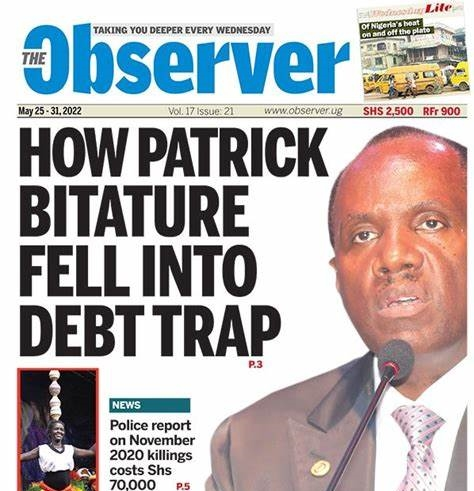

The Observer, Uganda’s best-known weekly, is looking for buyers, according to BbegMedia, a Kampala news website. Citing unnamed sources, the website reported two weeks ago that the newspaper, launched in 2004, could be sold for shs1bn.
But finding a buyer ready to part with shs1bn is going to be fiendishly difficult. In many countries, newspapers are loss-making enterprises run on shoestring budgets. The culprit for their woes is technology, of course, which has disrupted traditional sources of revenue and created spaces where most people now find their news.
In Uganda, the New Vision, once the leading daily and the only one listed on the stock exchange, has made losses for four straight years and is reportedly planning staff layoffs later this year.
Selling a newspaper, even in high-income countries with a strong reading culture, is not a walk in the park—unless the newspaper is profitable or has the potential for profitability.
Compared to tech companies, newspapers struggle to fetch big money. While tech companies fetch billions of dollars for their owners, newspaper owners often settle for millions.
A few good examples will drive my point home. Britain’s Telegraph was bought by the Barclays brothers in 2004 for £665m ($830 million), and Arianna Huffington sold the Huffington Post in 2011 to AOL for $315m.
Amazon’s founder Jeff Bezos bought The Washington Post in 2013 for $250m. China’s e-commerce giant, Alibaba, bought the South China Morning Post in 2015 for $266m. And Al Jazeera Media Network acquired Al Gore’s Current TV for $500m.
Yet when Microsoft snapped up LinkedIn in 2016, it paid $26.2bn, the largest acquisition in its history. Before LinkedIn was sold, it bought online learning business Lynda.com for about $1.5 billion.
A newspaper company that is more valuable than a comparable tech company is hard to find. In fact, apart from the Financial Times, based in London but owned by the Japanese media group Nikkei since 2015, I do not know of a newspaper in recent years that sold for more than a billion dollars. (Nikkei, which publishes Japan’s biggest-selling business newspaper [called] Nikkei, bought the FT for $1.3bn.)
Million-dollar question
Back to the Observer. It has been around for more than 20 years but has made losses for (almost) the better part of its existence. To be fair, its journalism has been admirable, and I have sometimes quoted its stories when writing opinion articles for Sunday Monitor.
Its founding editors/owners deserve medals for their resilience, grit and determination as it is extremely challenging to keep a newspaper alive in this harsh economic environment, which has killed newspapers, some before they even celebrated their first anniversary.
But investors with the wherewithal to buy a newspaper are not interested in grit and resilience. The million-dollar question they will be asking is: What is there to buy at the Observer?
The Observer’s greatest disadvantage is that it has zero assets. It rents its premises and has a skeleton staff of about 15, with only three shareholders, after the departure and demise of other shareholders, according to a knowledgeable source who declined to be named because they did not want to be viewed as scuppering the deal.
Apart from the Observer’s brand—not the strongest—computers, furniture and other office equipment in the newsroom, the newspaper has pretty much nothing to impress a potential buyer.
Sometimes investors ignore a lack of assets and focus on a company’s potential for profitability. For example, a solid readership base and a strong digital presence would work to the Observer’s advantage. But the newspaper sells between 1,000 and 2,000 copies every week. Its website had a revamp recently for the first time in almost 20 years.
That is what leads me to the conclusion that although the company is seeking a billion shillings, it is going to be extremely lucky to find a buyer ready to pay just shs300m.
The Observer’s owners may think I am raining on their parade or have been “bought” to become the dealbreaker, but nothing could be further from the truth. I am only stating the obvious. The facts are not pleasant to read, but they have to be made public. Reality, as one man famously remarked, cannot be defeated.
🔴 Musaazi Namiti is the Founder and Editorial Director of OJ-UGANDA. He previously led the Africa Desk at Al Jazeera in Doha, Qatar, worked for Globe Media Asia in Cambodia and writes a widely read column for Uganda’s Sunday Monitor. His work has been quoted by The New York Times, The Guardian, The Wall Street Journal, Jeune Afrique, The Africa Report—not for playing it safe, but for saying what others will not.
Email: musaazinamiti@ojuganda.com
X: @kazbuk